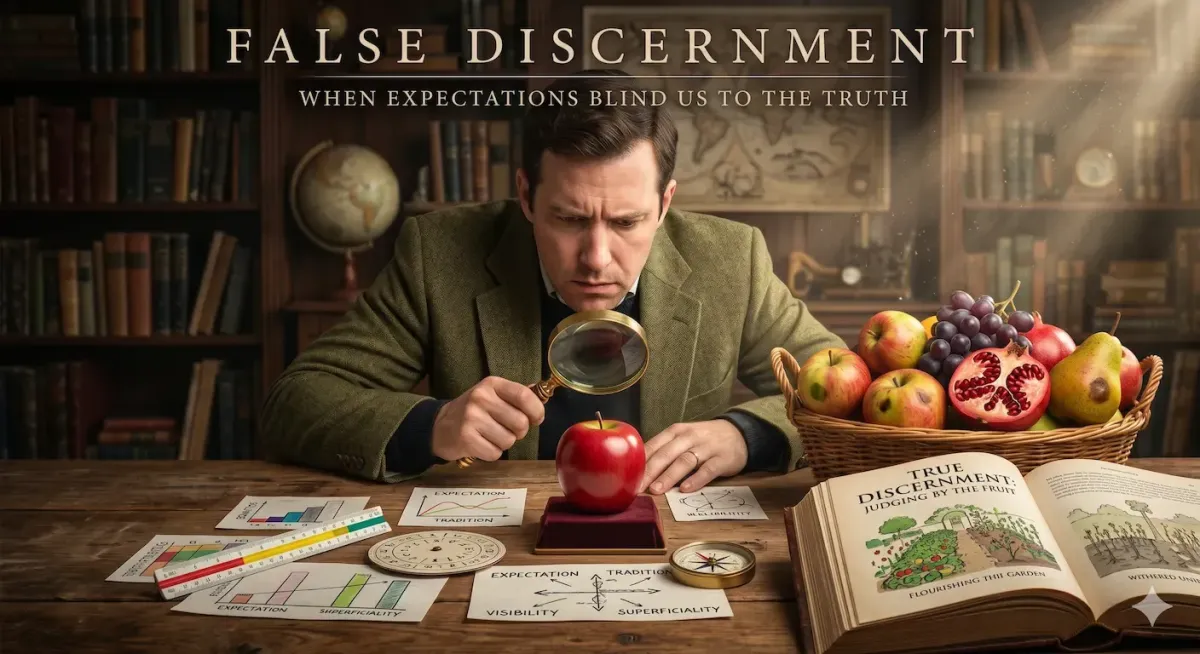
What You've Been Calling Discernment Isn't Discernment
What You've Been Calling Discernment Isn't Discernment
How to tell trained sifting from reactive labeling — and why most humans never learn the difference
By EL Cruz · Phoenix Project Foundation USA
Category: Consciousness as a Skill (CaaS) · Mental Wellness · Ancient Wisdom & Science
Feel free to watch the video, listen to the audio, and read this research article on discernment.
What You've Been Calling Discernment Isn't Discernment
What You've Been Calling Discernment Isn't Discernment
What Discernment Actually Means
Distortion 1 — Discernment as the Spiritual Brand for Prejudice
Distortion 2 — Discernment as License to Disengage
Distortion 3 — Discernment as Performance
Distortion 4 — Discernment as a One-Time Event
Distortion 5 — Discernment as Moral Verdict on Others
Distortion 6 — Discernment Confused with Intuition
Question 1: Did I become quieter before I "discerned" — or louder?
Question 2: Am I holding the conclusion lightly — or gripping it?
Question 3: Did I sift — or did I react and label?
Question 4: Am I willing to update if new information arrives?
You've heard the word a thousand times.
"I have discernment about that person."
"I'm discerning that this isn't aligned for me."
"I discerned that this was the right path."
The word gets thrown around in spiritual communities, leadership circles, coaching conversations, and faith spaces like it means something specific. Most humans nod along. Most humans use it themselves.
Most humans have no idea what they're actually saying.
Because here's the watchman's truth, fam — what gets called "discernment" in modern spiritual culture is, more often than not, something else wearing the costume of wisdom.
It might be prejudice in a robe. It might be avoidance with a halo. It might be a trauma response that got promoted to spiritual gift. It might be ego protecting its position. It might just be a fast reaction with a slow word attached.
Real discernment is rare. False discernment is everywhere. And the cost of confusing the two is enormous — broken relationships, missed callings, decisions you cannot defend later, and humans dismissed from your life who were actually trying to show you something you needed to see.
This is a teaching about telling the difference.
What Discernment Actually Means
The English word discernment comes from the Latin discernere — dis (apart) plus cernere (to sift, to separate). Literally: to sift apart.
Imagine a farmer holding a tray of mixed grain in their hands, slowly separating the wheat from the chaff. That's the picture. Discernment is the sifting itself — not the conclusion, not the verdict. The patient, attentive, careful separation of what is true from what only appears true.
Every wisdom tradition on Earth has named this practice — and remarkably, they all teach the same thing:
- Hebrew — binah (בִּינָה) — understanding, the ability to distinguish between things that look similar but are different. Root: bein (between). Discernment is what happens between things.
- Arabic — tamyiz (تَمْيِيز) — distinguishing, separating one thing from another. Sister word to the Hebrew binah through the shared Semitic root.
- Sanskrit — viveka (विवेक) — discrimination between the real and the unreal, the eternal and the temporary. Central to yogic and Hindu spiritual training.
- Greek — diakrisis (διάκρισις) — judging through. Same root as the English word crisis — the moment of distinguishing.
Four ancient cultures. Four different tongues. One unified teaching.
This is not coincidence, fam. This is universal human revelation. Source has been speaking the same truth to every culture in their own language for thousands of years: discernment is the sacred practice of sifting.
And in every tradition, it is a gift from Source that requires training to unwrap.
The capacity is given. The skill is developed. The training is what makes the gift operational.
The Six Distortions
Here's where most humans get into trouble, fam. We've forgotten what real discernment looks like, so we've started calling other things by its name. Six common distortions show up across spiritual culture, and once you can see them, you can't unsee them — in others or in yourself.
Distortion 1 — Discernment as the Spiritual Brand for Prejudice
Sounds like: "I have discernment about that person."
What's really happening: "I don't like them, and I'm dressing it up in spiritual language."
The word becomes a cover for what is actually fear, bias, jealousy, or unprocessed projection. No sifting has occurred. A reaction was had, and the reaction got retroactively labeled as wisdom.
Distortion 2 — Discernment as License to Disengage
Sounds like: "I'm discerning that this isn't aligned for me."
What's really happening: "I'm uncomfortable, and I want a spiritual reason to leave."
Sometimes the disengagement is legitimate. Often it's avoidance wearing robes. Real discernment leans into the question. False discernment uses the word to escape it.
Distortion 3 — Discernment as Performance
Sounds like: "I have to discern this carefully."
What's really happening: "I want to look spiritually mature in front of others while I think about it."
The word becomes social signaling. The actual sifting never happens. The mature human rarely announces they are discerning. They simply do it.
Distortion 4 — Discernment as a One-Time Event
Sounds like: "I discerned that this was the right path."
What's really happening: "I made a decision once. I'm not revisiting it. I'm not updating it. Period."
Said once. Six months later, the path is clearly wrong. The human never updates because they think discernment was a moment, not a practice. Real discernment is continuous.
Distortion 5 — Discernment as Moral Verdict on Others
Sounds like: "I have to use discernment about who I let in my life."
What's really happening: "I'm cutting humans off without examination and labeling them as low vibration or not aligned."
Sometimes legitimate boundary-setting requires sifting. But often this gets used to dismiss difficult mirrors — the humans who challenge us, who reflect back our blind spots, who don't reinforce our preferred story.
Distortion 6 — Discernment Confused with Intuition
Sounds like: "My discernment is telling me..."
What's really happening: "I'm having a felt sense and treating it as automatic truth without doing the sifting work."
Intuition is the felt sense. Discernment is the trained sifting of what the felt sense produces. Intuition can be true OR distorted by trauma, conditioning, fear, or projection. Discernment is what you do with intuition to tell which is which.
Modern spiritual culture has collapsed these two into one word — and lost the more important one.
The Four-Question Test
If you suspect discernment is happening — either in yourself or someone else — these four honest questions will tell you what's actually going on.
Question 1: Did I become quieter before I "discerned" — or louder?
Real discernment requires interior silence first. The mind slows. The breath deepens. The body settles. Then the sifting happens.
False discernment arrives loud. Chest tightens. Pulse rises. The conclusion arrives before the slowing down.
Question 2: Am I holding the conclusion lightly — or gripping it?
Real discernment leaves room for being wrong. The conclusion is held with an open hand. "This is what I'm seeing now. I could see differently as more information arrives."
False discernment grips the conclusion like identity. Challenging it feels like personal attack.
Question 3: Did I sift — or did I react and label?
Real sifting takes time. It involves multiple perspectives, considered against each other. Evidence examined. Sources questioned.
False discernment is instant. The body produces the response, and the mind retroactively assigns the spiritual label. If the "discernment" happened in two seconds, it probably wasn't.
Question 4: Am I willing to update if new information arrives?
Real discernment is a posture, not a verdict. The discerning human stays curious, watches the situation unfold, revises without shame.
False discernment is rigid. Once the verdict is in, no new evidence can move it.
The Scoring:
- 3 or 4 honest yeses? → Probably real discernment.
- 2 or fewer? → Something else is operating. And that something else might be the actual signal worth examining.
Why This Matters
The mental health crisis we are facing as a species is not only about clinical conditions. It is also about the slow erosion of trust — in ourselves, in each other, in the institutions that were supposed to hold us.
When humans cannot tell trained discernment from reactive labeling, three things happen:
One. They make decisions they cannot defend later, then double down to protect the ego rather than update.
Two. They cut humans out of their lives who were actually trying to help them — and surround themselves with humans who only confirm what they already believe.
Three. They become unable to recognize false counsel — and start accepting "guidance" from voices that have not earned the right to guide them.
The cost compounds. Year after year. Relationship after relationship. Decision after decision. Until the human looks around at age 50 and wonders why their life feels so much smaller than it was supposed to be.
This is what The Healing Centers are being built to address.
This is what Consciousness as a Skill (CaaS) trains.
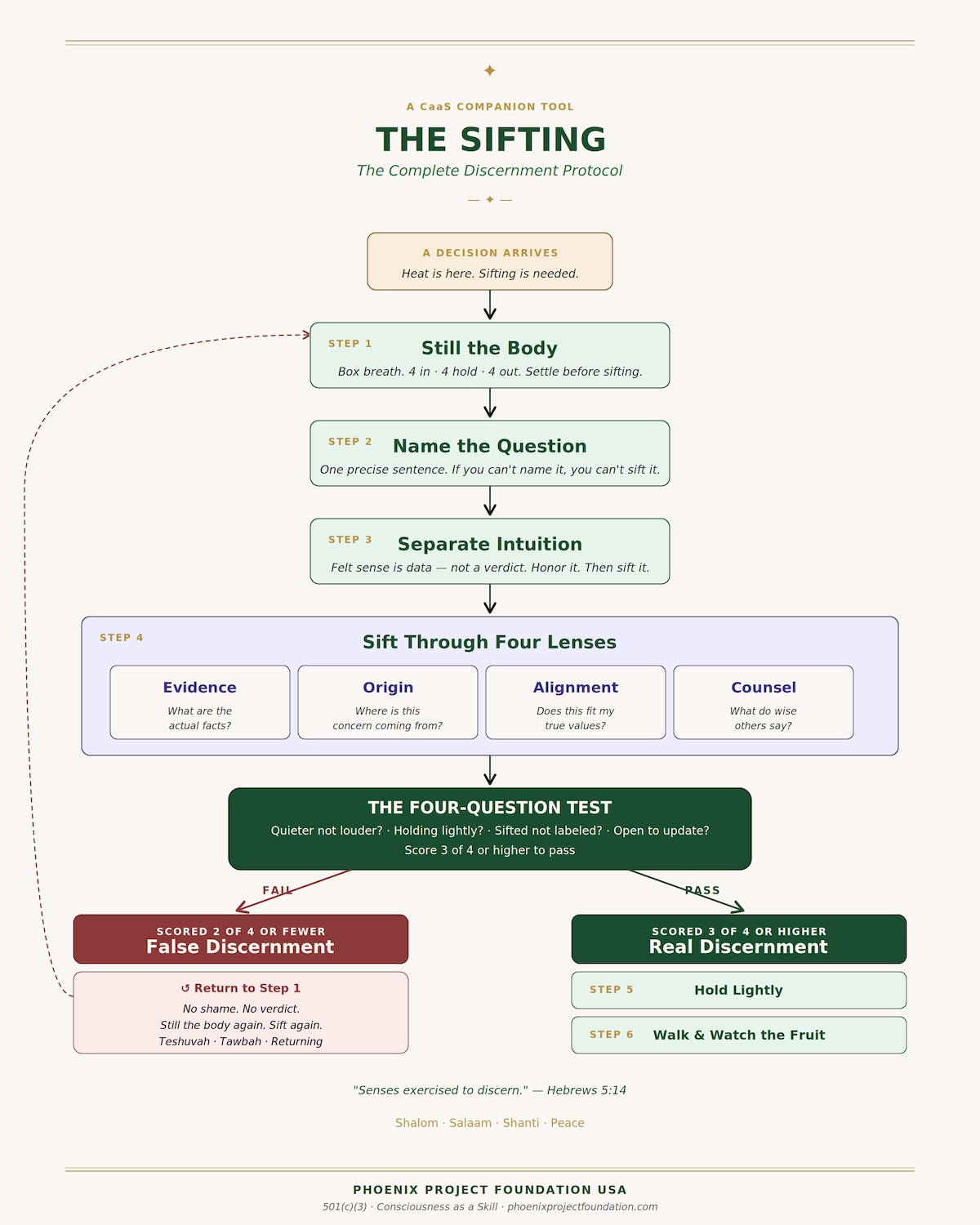
This is what The Sifting is — the complete protocol for unlearning false discernment and remembering the real practice.
What Comes Next
This blog post is the surface, fam. A taste.
The complete teaching includes:
- The full cross-cultural witness — Hebrew, Arabic, Greek, Sanskrit, Buddhist, Yorùbá, Tao, and Christian scripture all paired with plain-words decoding so a 10-year-old can understand
- The Six-Step Sifting Protocol — the actual practice for live decisions, from stilling the body through walking the fruit
- The Four Lenses — Evidence, Origin, Alignment, Counsel — and how to apply each one to real questions
- The Six Watchman's Warnings — including the Corruption of Counsel (wolves in sheep's clothing) and how to protect yourself from false prophets
- Daily, weekly, and monthly practice templates — to train the discernment muscle until it becomes second nature
- The visualized protocol diagram — a single-page map you can print, frame, and reference for life
- Foundation scenarios — real-life applications for partnerships, family, spiritual community, and major life decisions
The complete Consciousness as a Skill scroll — The Sifting: A Complete Discernment Survival Guide — is available to members of Team Human Channel.
We built this for one reason, fam: to silence the noise. So that any human who wants to learn real discernment has one place to go for the complete teaching. No more confusion. No more guessing. No more false discernment masquerading as wisdom.
Join Team Human Channel
Inside the Channel, you'll find:
The complete Sifting guide in downloadable Word, PDF, and visual formats
The Sifting Protocol Diagram (SVG, PNG, PDF) for printing and personal use
The Soft Answer Companion Tool — the sister practice for rewiring the tongue
Live teachings, daily wisdom drops, and the Foundation's full Consciousness as a Skill library
A community of seekers, coaches, veterans, and watchmen walking the Pro Human path together
The work of discernment is one of the slowest and most important spiritual practices to develop. It is also one of the most quietly powerful. The discerning human at 60 sees what the rest of the world cannot see — not because they are special, but because they exercised the gift they were already given.
Start now. The training reveals what is already yours.
"Solid food belongs to those who are of full age, those who by reason of use have their senses exercised to discern both good and evil."
— Hebrews 5:14
Shalom · Salaam · Shanti · Peace
Go Team Pro Human. 🕊
Phoenix Project Foundation USA is a 501(c)(3) nonprofit organization (EIN: 33-3471805) dedicated to addressing the global mental health crisis through The Healing Centers, Consciousness as a Skill (CaaS), and physical human potential infrastructure. Learn more at [phoenixprojectfoundation.com](https://phoenixprojectfoundation.com). If you or someone you love is in crisis, call or text 988.